Navigating the world of office chairs means considering every detail, down to the very wheels that allow you to glide through your workspace. Often overlooked, casters play a critical role in your chair’s performance, influencing everything from floor protection to your overall ergonomic comfort and daily productivity. Choosing the wrong type can lead to frustrating resistance, annoying noise, and even costly damage to your flooring. This guide will meticulously break down the differences between hard floor casters and carpet casters, helping you identify precisely what your ergonomic chair needs to move effortlessly across any surface.
1. What Are Casters?
Casters are essentially the wheeled components attached to the base of your office chair, enabling mobility and movement. Far more than simple wheels, they are engineered to interact with specific floor types, providing a seamless rolling experience that significantly impacts your daily interactions with your workspace. Understanding their function is the first step toward optimizing your ergonomic setup.
1.1. Definition of Caster
|
Our Picks for the Best Ergonomic Chair in 2026
As an Amazon Associate I earn from qualifying purchases.
|
||
| Num | Product | Action |
|---|---|---|
| 1 | TRALT Office Chair - Ergonomic Desk Chair with Adjustable Lumbar Support, Mesh Computer Chair, Executive Chairs for Home Office Comfortable Lumbar Support (Black) |

|
| 2 | TRALT Office Chair Ergonomic Desk Chair, 330 LBS Home Mesh Office Desk Chairs with Wheels, Comfortable Gaming Chair, High Back Office Chair for Long Hours (Black) |
|
| 3 | Fizzin Ergonomic Office Chair, 400 LBS Computer Chairs with Adjustable Lumbar Support, Breathable Mesh Desk Chair Ergonomic with Thickened Cushion, Comfy Home Office Desk Chair (Black) |
|
| 4 | Sweetcrispy Office Computer Desk Chair, Ergonomic High-Back Mesh Rolling Work Chairs with Wheels and Adjustable Headrests, Comfortable Lumbar Support, Comfy Flip-up Arms for Home, Bedroom, Study,Black |
|
| 5 | Marsail Ergonomic Office Chair: Office Desk Chair with High Back Mesh and Adjustable Lumbar Support Rolling Work Swivel Task Chairs with Wheel 3D Armrests and Headrest |
|
| 6 | PatioMage Ergonomic Office Chair, Big and Tall Desk Chair with Adjustable Lumbar Support & Seat Depth, High Back Computer Chair, Swivel Mesh Chairs with Wheels for Home Office, Black |
|
| 7 | Ergonomic Office Chair with Footrest - Adjustable Lumbar Support & Headrest, 90-160° Reclining Mesh Back Computer Chair - Home Office/Gaming, 350lbs Capacity (SGS Certified) |
|
| 8 | Marsail Ergonomic Office Chair Ergonomic Gaming Chair with Lumbar Support, 2D Headrest, Adjustable Armrests, Contoured Seat Cushion, Computer Desk Chair with Wheels for Home and Office |
|
| 9 | Ergonomic Office Chair with Footrest - Adjustable Lumbar Support & Headrest, 90-160° Reclining Mesh Back Computer Chair - Home Office/Gaming, 350lbs Capacity (SGS Certified) |
|
| 10 | Ergonomic Office Chair, Mesh Seat Cushion with 3D Armrests and 3D Headrest, Adjustable Lumbar Support with 90-120° Rocking Function, SGS Class 4 Gas Clylinder, Black |
|
At its core, a caster is a mechanical device comprising a wheel, a housing, and a stem or mounting plate that connects it to the chair’s base. These components work in unison to allow your chair to move freely across various surfaces. The material and design of the wheel are paramount, as they dictate how the caster performs on different floor types, affecting friction, noise, and floor longevity.
1.2. Benefits of Choosing the Right Casters
Selecting the appropriate casters for your ergonomic chair offers a multitude of benefits that extend beyond mere mobility. Correct casters ensure your chair glides smoothly, reducing the physical effort required to move around your desk. They are also crucial for preserving your flooring, preventing unsightly scratches, dents, or premature wear. Moreover, the right casters contribute to a quieter environment by minimizing unwanted rolling noise, and they enhance ergonomic comfort by allowing you to shift positions effortlessly without straining your body.
- Improved Mobility and Ease of Movement: Effortless gliding across your workspace.
- Reduced Wear and Tear on Flooring: Protection against scratches, scuffs, and dents.
- Prevention of Noise and Scraping: Quieter operation, especially in shared environments.
- Enhanced Ergonomic Comfort: Less strain from pushing or pulling a resistant chair.
2. Key Differences: Hard Floor Casters vs. Carpet Casters
The fundamental distinction between hard floor casters and carpet casters lies in their material composition and design, which are optimized for vastly different surface interactions. While both serve to mobilize your chair, their performance characteristics, durability, and impact on your flooring vary significantly.
2.1. Hard Floor Casters
Hard floor casters, often referred to as soft casters, are specifically engineered to protect delicate hard surfaces like hardwood, laminate, tile, vinyl, and concrete.
- Materials: These casters are typically made from softer materials such as rubber, soft polyurethane, or thermoplastic rubber (TPR). This softer composition allows the wheels to conform slightly to the floor’s surface.
- Performance: On hard floors, soft casters provide excellent grip, preventing unwanted sliding and offering controlled movement. Their material’s elasticity also helps absorb minor bumps and vibrations, leading to a quieter rolling experience. They are designed to roll smoothly without marking or scratching the floor.
- Benefits:
- Superior Floor Protection: The soft material prevents damage, scuffs, and dents.
- Reduced Noise Level: Roll quietly, minimizing distractions.
- Enhanced Grip and Control: Prevents the chair from sliding excessively.
- Shock Absorption: Cushions movement over uneven surfaces.
- Drawbacks: When used on carpeted surfaces, soft casters tend to sink into the fibers, creating high rolling resistance. This makes the chair harder to move and can lead to faster wear on the casters themselves.
2.2. Carpet Casters
Carpet casters, often known as hard casters, are designed to glide efficiently over various carpet types, from low-pile to thicker, plush carpets.
- Materials: These casters are generally constructed from harder, more rigid materials like hard nylon, polypropylene, or hard polyurethane. Some industrial-grade casters might even incorporate metal.
- Performance: The hard material allows carpet casters to roll over carpet fibers without sinking in, significantly reducing rolling resistance. This makes it easier to move the chair on soft surfaces. For medium or high-pile carpets, larger diameter casters or twin-wheel designs are often recommended to further reduce resistance and distribute weight effectively.
- Benefits:
- Low Rolling Resistance on Carpet: Effortless movement across carpeted floors.
- High Durability on Carpet: Designed to withstand continuous use on soft surfaces.
- Higher Load Capacity: Their rigid construction often allows them to handle more weight without deforming.
- Drawbacks: Using hard casters on hard floors can be problematic. Their rigidity means they do not deform to absorb small particles, leading to grinding debris into the floor and causing scratches, scuffs, or dents. They also tend to be much noisier on hard surfaces.
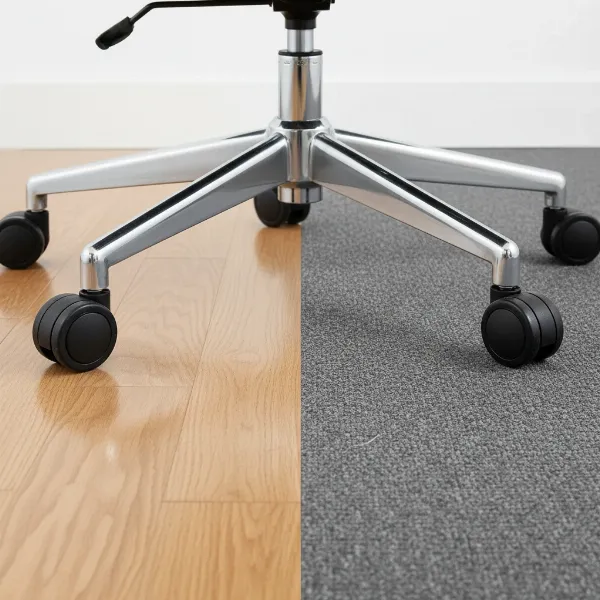 An office chair with two different types of casters, one suitable for hard floors and one for carpet, on a split floor surface to illustrate their application.
3. Comparison Table of Caster Types
To further clarify the distinctions, here’s a detailed comparison of hard floor (soft) casters and carpet (hard) casters:
| Aspect | Soft Casters (Hard Floor) | Hard Casters (Carpet) |
|---|---|---|
| Materials | Rubber, TPR, soft polyurethane | Nylon, polypropylene, hard polyurethane, metal |
| Floor Protection | Excellent on hard floors | Not recommended for hard floors (risk of damage) |
| Rolling Resistance | Higher on carpet, very low on hard floors | Lower on carpet, higher on hard floors |
| Noise Level | Pretty quiet on hard floors | Can be loud on hard floors, quieter on carpet |
| Load Capacity | Lower for the same size | Higher for the same size |
| Stability | Better grip on hard floors (chair stays put) | Can slide on smooth floors, holds on carpet |
| Best Use | Hardwood, laminate, tile, vinyl, concrete floors | Low-pile to high-pile carpet |
4. Guide to Choosing the Right Casters
Making an informed decision about your chair casters involves evaluating your specific environment and needs. The right choice not only extends the life of your chair and flooring but also significantly improves your daily comfort and productivity.
4.1. Identify Your Needs
Before purchasing, consider how and where your chair will be used.
- Daily Usage Time: For prolonged sitting, smooth and effortless movement is crucial to prevent strain.
- Floor Type: This is the most critical factor. Accurately identify your flooring material (hardwood, laminate, tile, vinyl, low-pile carpet, high-pile carpet).
- Noise Sensitivity: If you work in a quiet environment, such as a home office, library, or shared workspace, minimizing caster noise is a key consideration.
- Budget: While quality casters are an investment, they vary in price. Balance cost with desired performance and durability.
4.2. Essential Caster Features
Beyond the basic type, look for specific features that enhance performance and longevity.
- Material Compatibility: Always match the caster material to your floor type. Soft materials (rubber, polyurethane) for hard floors; hard materials (nylon) for carpets.
- Wheel Diameter: Larger wheels (e.g., 65mm+) generally offer lower rolling resistance and better ergonomics, especially on high-pile carpets. Smaller wheels may experience more stress and be harder to roll.
- Stem Fit: Ensure the replacement casters are compatible with your chair’s base. Common stem sizes are 10mm and 11mm; measure accurately.
- Bearings: Casters with ball bearings tend to last longer and roll smoother than those with sleeve bearings, requiring less maintenance.
- Twin-Wheel vs. Single-Wheel: Twin-wheel casters often provide a wider surface for better weight distribution and easier changes in direction.
4.3. Caster Materials
The material of the caster wheel is the primary determinant of its performance.
- Nylon: A hard plastic material, ideal for carpeted surfaces. It offers durability and low rolling resistance on carpet.
- Rubber: A soft material, excellent for hard floors due to its grip, quiet operation, and floor-protecting qualities.
- Polyurethane (PU): A versatile material that can be engineered to be soft (for hard floors) or hard (for carpets). Soft PU casters are highly protective and grippy on hard surfaces, while hard PU offers good durability on carpets.
- Metal: Typically used in heavy-duty or industrial casters, offering maximum strength and durability, but can be noisy and damaging on hard floors without protective coatings.
4.4. Testing and Trying
Before committing to a set of casters, consider these steps:
- Read Online Reviews: Look for feedback from users with similar flooring types.
- Verify Compatibility: Double-check the stem size and load capacity to ensure they are suitable for your chair and your weight.
- Consider Universal Options: For mixed environments, dual-wheel casters with a hard center and soft tread can offer a decent compromise, though they may not excel on either surface compared to specialized casters.
5. Popular Caster Solutions and Considerations
Beyond the standard types, various caster solutions and related products cater to specific needs, enhancing the functionality and protection your ergonomic chair offers.
5.1. High-End Casters
Premium casters often feature high-quality materials like precision-engineered polyurethane or specialized rubber blends, coupled with advanced ball bearings. These provide exceptionally smooth, silent operation, superior floor protection, and enhanced durability, making them a worthwhile investment for expensive flooring or heavy daily use.
5.2. Budget-Friendly Casters
Entry-level casters typically use basic hard nylon or plastic. While suitable for low-pile carpets, they may wear out faster and offer less floor protection and quieter operation. It’s important to understand these trade-offs to manage expectations and avoid potential floor damage.
5.3. Casters for Gamers
Gamers often prioritize smooth, unrestricted movement and quiet operation. Many gaming chairs come with casters designed for performance on both carpet and hard floors, frequently utilizing soft polyurethane rollerblade-style wheels that glide effortlessly and quietly while protecting surfaces.
5.4. The Role of Chair Mats
If replacing casters isn’t an option, or if you have mixed flooring types, a chair mat can be an excellent solution. A chair mat creates a consistent, protective surface over your existing floor, allowing any type of caster to roll smoothly without causing damage.
- For Hard Floors: Prevents scratches, scuffs, and dents from hard casters.
- For Carpets: Prevents casters from sinking into the pile, ensuring smooth movement.
- For Mixed Surfaces: Provides a uniform transition area, preventing your chair from getting stuck.
“Many people overlook their chair’s wheels, but the right casters can truly transform your workspace, offering silent movement and safeguarding your valuable flooring for years to come.” – Sarah Jenkins, Ergonomics Specialist at ErgoSolutions Co.
6. Maintenance and Replacement
Even the best casters require regular care to maintain optimal performance and longevity. Proper maintenance can prevent common issues like squeaking, sticking, and premature wear.
6.1. Regular Cleaning
Casters are prone to accumulating hair, dust, carpet fibers, and other debris around their axles. This buildup can increase friction, hinder movement, and eventually seize the wheels. It is recommended to:
- Clean Casters Monthly: Turn your chair upside down and manually remove any tangled debris. A small brush or compressed air can be helpful.
- Inspect Regularly: Check for any visible cracks, flat spots, or excessive wobbling.
6.2. Lubrication
The bearings within your casters can benefit from occasional lubrication to ensure smooth and quiet operation.
- Lubricate Every 2-3 Months: Apply a small amount of light machine oil or silicone spray to the swivel mechanisms and wheel axles, following the manufacturer’s recommendations.
6.3. When to Replace Casters
Casters, like any moving part, will eventually wear out. Look for these signs that it’s time for a replacement:
- Visible Damage: Cracks, chips, or flat spots on the wheel material.
- Increased Resistance: Your chair becomes noticeably harder to roll.
- Excessive Noise: Persistent squeaking or grinding that cannot be remedied by cleaning or lubrication.
- Unstable Movement: The chair wobbles or feels uneven when rolling.
Typically, casters on a heavily used ergonomic chair might need replacement every 2-3 years. When replacing, always opt for a full set of identical casters designed for your specific floor type to ensure balanced movement and prevent safety hazards.
Conclusion
Choosing between hard floor casters and carpet casters is not a one-size-fits-all decision; it’s a critical choice that directly impacts the functionality of your Ergonomic Chair and the longevity of your flooring. By understanding the distinct characteristics of each type – their materials, performance, and ideal applications – you can make an informed decision tailored to your specific environment. Investing in the right casters ensures effortless mobility, protects your valuable floors from damage, and contributes significantly to a more comfortable and productive workspace. Don’t let the wrong wheels hold you back; upgrade your ergonomic experience today.
What kind of flooring does your workspace have, and are your current casters truly optimized for it?
Frequently Asked Questions
What happens if I use hard floor casters on carpet?
Using soft, hard floor casters on carpet will likely result in increased rolling resistance, making your chair difficult to move. The soft material will sink into the carpet fibers, leading to a “stuck” feeling and potentially faster wear on the casters themselves. For smooth movement on carpet, hard casters are generally more effective.
Can I use carpet casters on hardwood floors without damage?
No, using hard plastic or nylon carpet casters directly on hardwood, laminate, or tile floors is highly discouraged. These rigid wheels can easily scratch, scuff, or even dent hard surfaces, leading to permanent and costly damage. Always opt for soft rubber or polyurethane casters for hard floors to ensure protection and quiet operation.